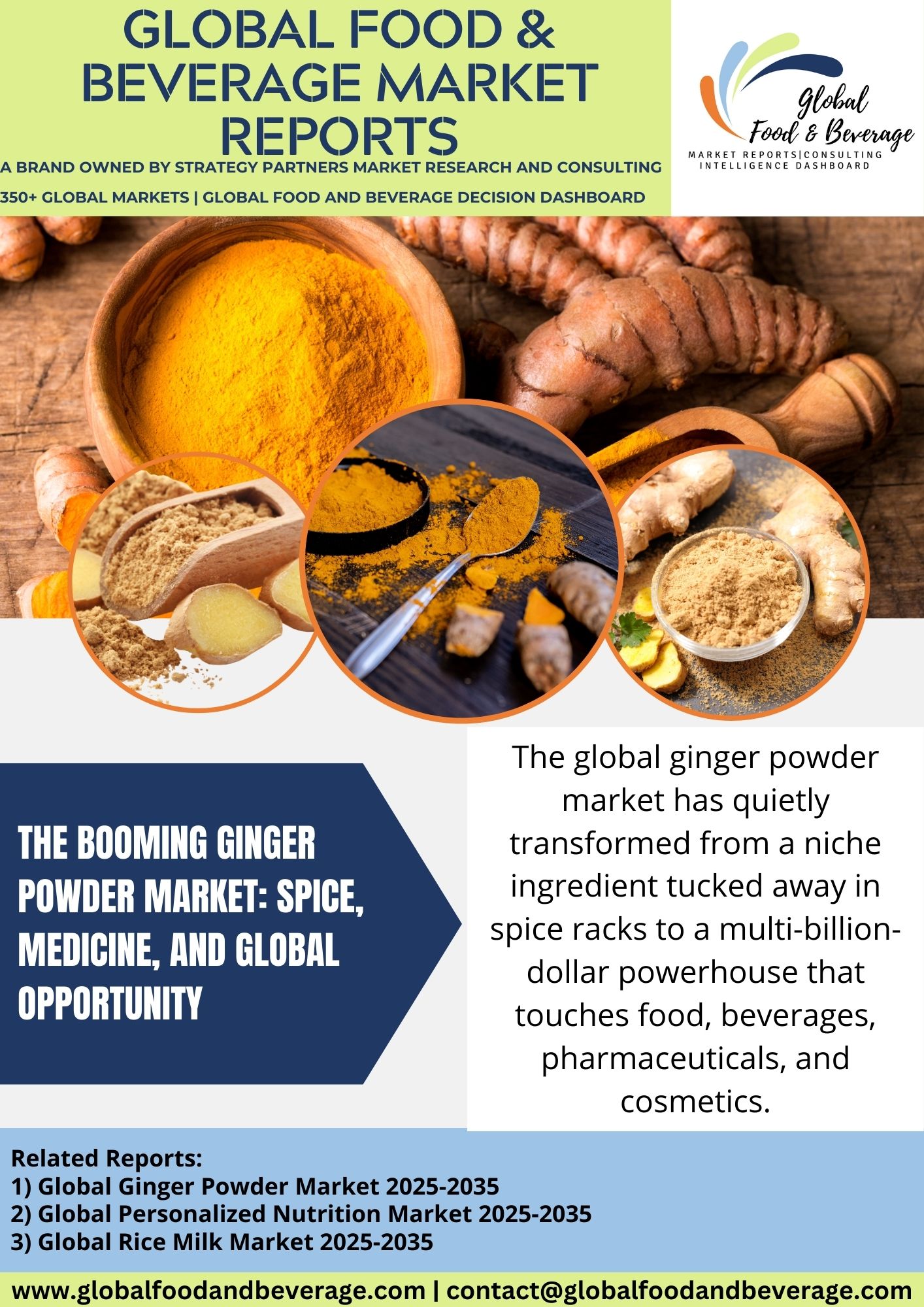
Global ginger powder market has quietly transformed from a niche ingredient tucked away in spice racks to a multi-billion-dollar powerhouse that touches food, beverages, pharmaceuticals, and cosmetics. What was once primarily associated with holiday cookies and nausea remedies has evolved into one of the most sought-after functional ingredients worldwide. Driven by rising health consciousness, clean-label trends, and the explosive growth of plant-based products, ginger powder is experiencing demand that shows no signs of slowing.
The journey of ginger from fresh root to fine powder begins in the tropical belts of Asia, Africa, and Latin America, but its final form as a shelf-stable, potent spice has unlocked markets that fresh ginger could never reach. Unlike its fresh counterpart, ginger powder offers consistency, longer shelf life, and concentrated bioactive compounds, making it indispensable for manufacturers who need reliable flavor and functionality year-round.
The Health Wave Fueling Demand
Consumers today are not just buying ginger powder for taste; they are buying it for wellness. Scientific studies continue to validate what traditional medicine has claimed for centuries: ginger possesses powerful anti-inflammatory, antioxidant, and digestive properties. The active compounds gingerol, shogaol, and paradol become even more bioavailable when ginger is dried and powdered, especially shogaol, which forms during the drying process and is linked to stronger anti-cancer and anti-nausea effects.
This convergence of ancient wisdom and modern science has created a perfect storm. From morning wellness shots to turmeric-ginger lattes that dominate café menus, ginger powder has become a staple in the functional food and beverage category. The COVID-19 pandemic further accelerated this trend as people sought natural immune-supporting ingredients, a behavior that has largely persisted post-pandemic.
Asia-Pacific: The Eternal Powerhouse
While ginger originated in Southeast Asia over 5,000 years ago, the region remains the undisputed leader in both production and consumption of ginger powder. India, the largest producer of ginger globally, processes a significant portion into powder form for both domestic use and export. The country’s Ayurvedic tradition ensures a robust internal market, while its competitive pricing dominates global trade.
China follows closely, with its advanced processing facilities and ability to produce high-quality, organic-certified ginger powder at scale. Nigeria has emerged as the dark horse, becoming the world’s third-largest ginger producer and increasingly focusing on value-added products like powder rather than exporting raw roots. These three countries form the backbone of global supply, but emerging producers in Thailand, Indonesia, and Peru are gradually challenging the status quo.
The Clean Label Revolution
Modern consumers read labels religiously, and “ginger powder” as a single ingredient fits perfectly into the clean eating narrative. Unlike many spices that require anti-caking agents or artificial colors, pure ginger powder needs nothing added. This simplicity has made it a darling of the natural products industry.
Food manufacturers have responded enthusiastically. Ginger powder now appears in everything from protein bars and electrolyte drinks to plant-based milks and superfood blends. Its natural sweetness and warmth allow formulators to reduce added sugars while enhancing flavor complexity, a win-win in an era where sugar reduction is a top priority.
Challenges on the Horizon
Despite the rosy outlook, the ginger powder market faces significant hurdles. Climate change poses the biggest long-term threat, with erratic rainfall and rising temperatures affecting yields in key growing regions. Diseases like rhizome rot have devastated crops in India and Nigeria in recent years, causing price volatility that ripples through global markets.
The industry also grapples with quality inconsistencies. Adulteration remains a concern in some exporting countries, where cheaper ingredients are sometimes mixed with genuine ginger powder. Sophisticated buyers now demand third-party testing and certificates of analysis, pushing producers toward greater transparency and investment in quality control.
Innovation and New Applications
Forward-thinking companies are exploring exciting new frontiers. Microencapsulated ginger powder, designed to mask its sharp taste while preserving bioactivity, is gaining traction in pharmaceutical applications. Water-soluble ginger powder variants are being developed specifically for the beverage industry, eliminating the sedimentation issues that plague traditional powders in ready-to-drink products.
The beauty and personal care sector has discovered ginger’s potential as well. Its warming properties and antioxidant profile make it ideal for anti-aging creams, scalp treatments, and even cellulite-reducing products. Ginger powder extracts are increasingly found in “detox” bath salts and warming massage oils.
Sustainability Takes Center Stage
As with many agricultural commodities, sustainability has moved from buzzword to business imperative. Major buyers now prioritize suppliers with regenerative farming practices, fair trade certification, and traceable supply chains. Smallholder farmers, who grow the majority of the world’s ginger, are receiving training in organic methods and soil conservation techniques.
Some companies have gone further, investing in vertical integration by establishing their own ginger farms or partnering directly with grower cooperatives. This not only secures supply but allows complete control over farming practices and quality standards from soil to shelf.
The Premiumization Trend
At the retail level, ginger powder has undergone a remarkable transformation. Gone are the days when it was solely a bulk commodity sold in plain packaging. Artisanal brands now offer single-origin ginger powders, highlighting specific growing regions the way coffee roasters promote different origins.
Javanese ginger powder commands premium pricing for its intense aroma, while Cochin ginger from India is prized for its high oil content. Some producers have begun aging ginger powder in oak barrels or blending it with other spices to create signature seasoning mixes, borrowing techniques traditionally used in the tea and coffee industries.
Looking Ahead
The ginger powder market stands at an interesting crossroads. On one hand, it benefits from powerful tailwinds: growing health awareness, expanding applications, and strong cultural resonance in both traditional and modern contexts. On the other, it must navigate climate risks, supply chain vulnerabilities, and the constant pressure to maintain quality in a commodity-driven market.
What seems certain is that ginger powder has secured its place as more than just a spice; it has become a versatile, functional ingredient with cross-category appeal. As consumers continue prioritizing natural, effective, and flavorful options, this ancient root in its modern powdered form appears poised for continued growth.
Conclusion
The next decade will likely see further consolidation among processors, increased investment in sustainable farming practices, and continued innovation in product forms and applications. For producers, traders, and manufacturers who can navigate the challenges while capitalizing on the opportunities, the ginger powder market offers that rare combination: a product deeply rooted in tradition yet perfectly positioned for the future.
Whether you’re a farmer in Kerala deciding whether to invest in drying facilities, a beverage brand formulator looking for the next big functional ingredient, or simply a consumer reaching for that familiar orange-brown powder in your spice cabinet, one thing is clear: ginger powder’s moment has arrived, and it’s just getting started.