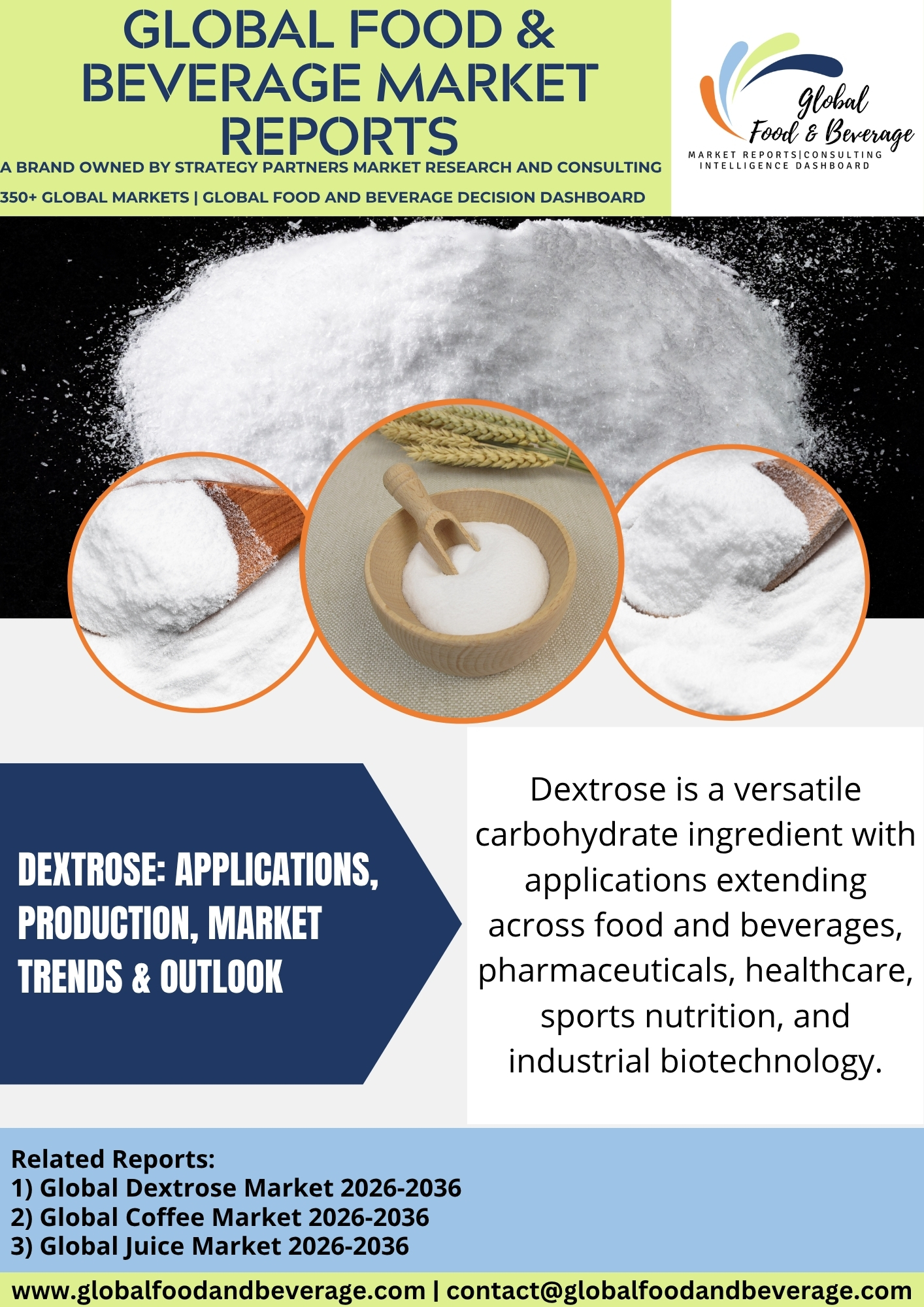
Dextrose is a simple sugar widely used across the food, beverage, pharmaceutical, healthcare, and industrial sectors. It is a form of glucose that provides a rapidly available source of energy and plays an important role in several manufacturing processes. Its versatility, easy digestibility, and broad range of applications have made dextrose an important ingredient in global industrial and commercial markets.
Growing demand for processed foods, sports nutrition, pharmaceutical products, and intravenous therapies is supporting the use of dextrose worldwide. At the same time, manufacturers are focusing on efficient production, improved purity, and sustainable processing methods.
What Is Dextrose?
Dextrose is a naturally occurring monosaccharide chemically identical to D-glucose. It is commonly produced from starch obtained from sources such as corn, wheat, rice, and potatoes. Through enzymatic or hydrolytic processing, starch is converted into glucose-rich products that can be further refined into different grades of dextrose.
Dextrose is available in several forms, including anhydrous dextrose and dextrose monohydrate. The choice depends on the intended application. Food manufacturers commonly use it as a sweetener, humectant, or fermentation substrate, while pharmaceutical applications require highly purified grades.
Evolution of the Dextrose Industry
The commercial production of dextrose expanded alongside developments in starch processing and industrial biotechnology. Earlier production methods relied heavily on acid hydrolysis. Advances in enzyme technology later enabled manufacturers to achieve greater efficiency, improved consistency, and better control over product characteristics.
Modern production facilities use advanced enzymatic conversion, purification, crystallization, drying, and quality-control technologies. These improvements have allowed producers to manufacture dextrose at large industrial scales while meeting increasingly strict food and pharmaceutical quality requirements.
The development of specialized grades has also expanded the market. Manufacturers can now produce products designed for food processing, beverages, clinical nutrition, pharmaceuticals, fermentation, and other industrial applications.
Importance of Dextrose
Dextrose is important because it combines functional properties with nutritional value. As a rapidly metabolized carbohydrate, it can provide a readily available source of energy. This makes it particularly relevant to medical and nutritional applications.
In the food industry, dextrose contributes sweetness, texture, color development, and moisture retention. It can also support fermentation in products such as baked goods and beverages.
In pharmaceutical applications, highly purified dextrose is used in intravenous solutions and other medical formulations. Its ability to provide glucose directly makes it an important component of clinical nutrition and fluid-management products.
Key Applications of Dextrose
Food and Beverages
Food and beverage manufacturing represents one of the major application areas for dextrose. It is used in bakery products, confectionery, dairy products, processed foods, sauces, beverages, and nutritional products.
Dextrose can improve browning during cooking and contribute to desirable flavor and texture. It can also help control crystallization and maintain product consistency in certain formulations.
Pharmaceuticals and Healthcare
Pharmaceutical-grade dextrose has an important role in healthcare. Dextrose solutions are used to provide carbohydrates and energy in clinical settings. The compound is also incorporated into various pharmaceutical formulations where controlled glucose delivery is required.
The growing healthcare sector and increasing demand for clinical nutrition products support continued consumption of pharmaceutical-grade dextrose.
Sports and Nutritional Products
Dextrose is widely used in sports nutrition because it can provide carbohydrates that are quickly available to the body. It is incorporated into energy powders, carbohydrate drinks, recovery products, and nutritional formulations.
The expansion of fitness and sports nutrition markets is creating additional opportunities for dextrose producers.
Fermentation and Industrial Applications
Dextrose serves as a carbon source for microorganisms in fermentation processes. It is therefore used in the production of products such as organic acids, enzymes, amino acids, and other biotechnology-based materials.
Its predictable composition and availability make it a useful feedstock for industrial fermentation.
Technological Advancements Driving Market Growth
Technology is playing an important role in improving dextrose production. Modern enzymatic processes can provide better conversion efficiency than traditional hydrolysis methods. Advanced purification systems also help manufacturers achieve the high purity required for pharmaceutical and specialized applications.
Automation and digital process monitoring are improving production consistency and reducing manufacturing losses. Manufacturers are also investing in energy-efficient equipment, water recycling, and improved waste-management systems.
Biotechnology is another important area of development. Improvements in enzyme technology can help optimize starch conversion while reducing processing time and resource consumption.
Growing Dextrose Production Supporting Market Expansion
Increasing demand from food processing, pharmaceuticals, sports nutrition, and industrial biotechnology is encouraging manufacturers to expand production capacity.
Corn remains an important raw material in many markets because of its availability and suitability for starch extraction. However, regional manufacturers may also use wheat, rice, or other starch sources depending on agricultural availability and production economics.
Producers are increasingly focused on flexible manufacturing systems that can supply different grades and specifications. This allows companies to serve multiple end-use industries while responding to changing customer requirements.
Increasing Demand for Dextrose and Product Upgrades
Demand for dextrose is closely connected to changing consumer and industrial trends. Growth in convenience foods and processed food consumption is increasing demand for functional carbohydrate ingredients.
At the same time, pharmaceutical companies require high-purity products with consistent specifications. This is encouraging manufacturers to improve quality-control systems and develop specialized pharmaceutical grades.
The sports nutrition sector is also creating demand for fast-acting carbohydrate ingredients. As consumers become more interested in fitness and performance nutrition, manufacturers are developing new formulations that incorporate dextrose with proteins, electrolytes, vitamins, and other nutritional ingredients.
Regional Market Developments
North America and Europe have established food, pharmaceutical, and biotechnology industries that support significant demand for dextrose. Advanced starch-processing infrastructure and strong pharmaceutical manufacturing capabilities further support the market.
Asia-Pacific is expected to remain an important growth region because of its expanding food-processing, pharmaceutical, healthcare, and nutritional industries. Rising industrialization and increasing consumption of packaged foods are creating opportunities for dextrose producers.
India and China are particularly important manufacturing and consumption markets. Growing pharmaceutical production and expanding food and beverage industries are likely to support regional demand.
Competitive Landscape
The dextrose market includes starch processors, ingredient manufacturers, pharmaceutical-grade suppliers, and diversified food-ingredient companies. Competition is influenced by product quality, production capacity, raw-material availability, pricing, distribution networks, and regulatory compliance.
Leading manufacturers are investing in production expansion, process optimization, product development, and sustainability initiatives. Companies are also seeking long-term relationships with food, pharmaceutical, and industrial customers.
Product differentiation is becoming increasingly important as customers demand consistent quality, specialized grades, and reliable supply.
Challenges Affecting Market Growth
Despite its broad applications, the dextrose industry faces several challenges. Raw-material price fluctuations can affect production costs and profitability. Changes in corn, wheat, and other agricultural commodity prices may directly influence manufacturing economics.
Energy and water consumption are also important concerns for starch processing and purification. Manufacturers must improve resource efficiency while maintaining product quality.
Regulatory requirements represent another challenge, particularly for pharmaceutical and food-grade products. Producers must maintain strict quality standards and comply with safety, labeling, and manufacturing regulations across different markets.
Competition from alternative sweeteners and carbohydrate ingredients may also influence demand in certain applications.
Future Outlook of Dextrose
The future of the dextrose industry looks promising as demand continues to grow across food, healthcare, pharmaceuticals, sports nutrition, and industrial biotechnology. Manufacturers are expected to focus on higher-purity products, specialized formulations, efficient production processes, and sustainable manufacturing.
Technological improvements in enzymatic processing and purification could further improve production efficiency. Meanwhile, growing interest in functional foods, clinical nutrition, and fermentation-based manufacturing may create new applications.
Sustainability will also become increasingly important. Producers are likely to invest in energy-efficient systems, water conservation, renewable energy, waste reduction, and improved utilization of agricultural raw materials.
Conclusion
Dextrose is a versatile carbohydrate ingredient with applications extending across food and beverages, pharmaceuticals, healthcare, sports nutrition, and industrial biotechnology. Its rapid availability as an energy source and useful functional properties make it valuable to a wide range of industries.
As global food processing, healthcare, pharmaceutical manufacturing, and biotechnology continue to expand, demand for dextrose is expected to remain strong. Future market development will depend on production efficiency, product innovation, raw-material availability, regulatory compliance, and sustainable manufacturing. These factors will shape the competitive landscape and create new opportunities for dextrose producers in the years ahead.