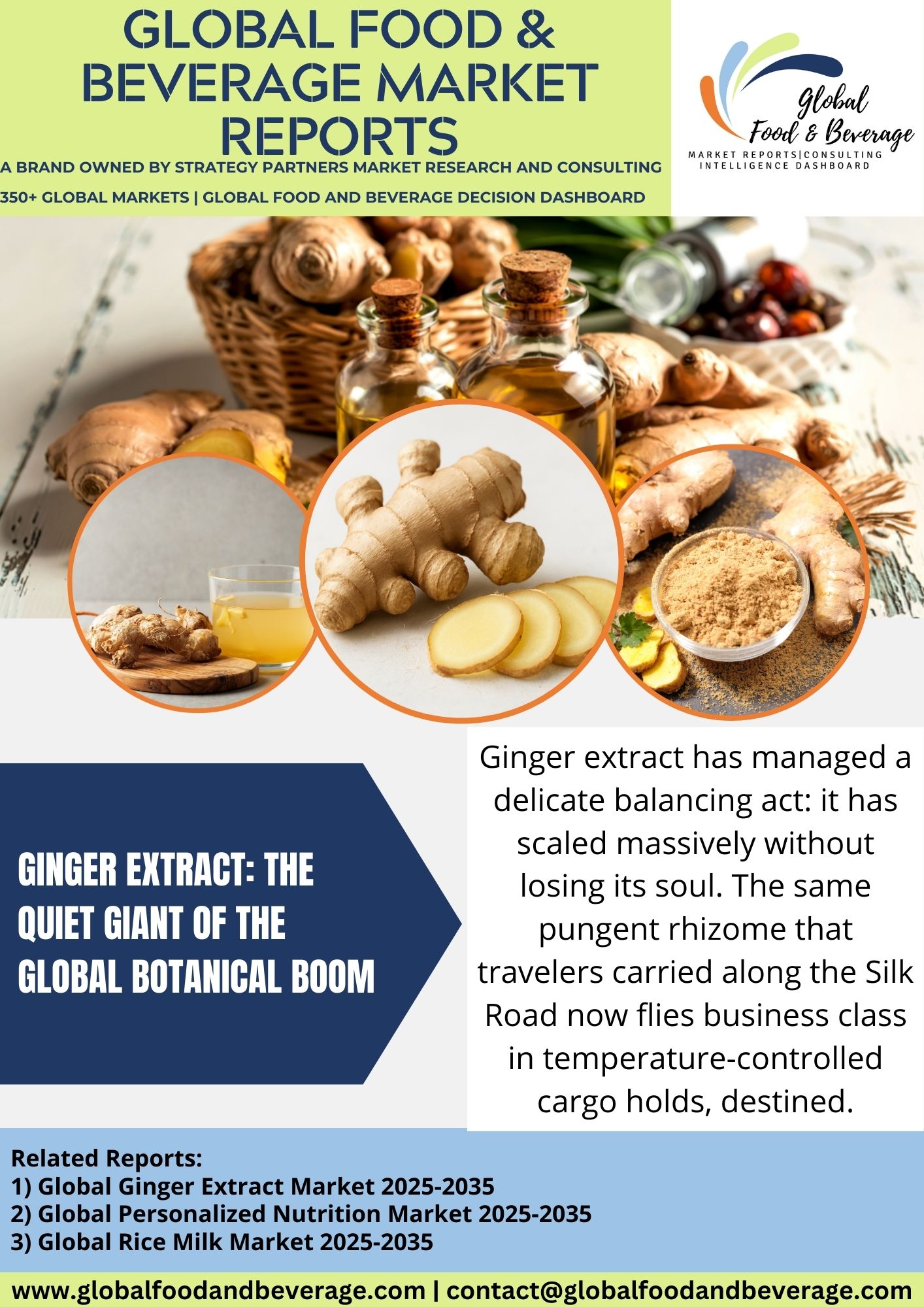
Ginger extract has moved from the spice rack to the center of the wellness economy with a speed that surprises even longtime industry watchers. What began as a traditional digestive aid in Asia and a folk remedy for colds in Europe has become one of the most sought-after standardized botanical ingredients on earth. The market is no longer driven by small herbal companies; it is shaped by multinational beverage giants, contract manufacturers running continuous extraction lines, and private equity firms quietly acquiring processing plants in coastal China and southern India. Ginger extract has achieved something rare: it is both ancient and cutting-edge, both affordable and premium, both grandmother-approved and clinical-trial-validated.
Today the rhizome is processed into pale golden supercritical CO₂ oils, dark viscous oleoresins, water-soluble powders, and ultra-concentrated beadlets designed to survive extreme heat in ready-to-drink bottles. Consumers encounter it in morning immunity shots, evening relaxation teas, joint-health capsules, clean-label ginger ales, and even luxury hair serums. The same plant that once flavored medieval ale now powers billion-dollar categories.
Side Topic One: The Standardization Revolution
The turning point came when high-performance liquid chromatography became cheap enough for every mid-sized extractor to own. Suddenly buyers could demand exact percentages of 6-gingerol, 8-gingerol, 10-gingerol, and 6-shogaol instead of vague “ginger flavor.” Certificates of analysis now read like pharmaceutical spec sheets, and reputable suppliers guarantee minimum total gingerol + shogaol content on every drum. This precision turned ginger extract from a commodity spice into a reliable active ingredient, opening doors to large-scale food, beverage, and supplement formulation that simply wasn’t possible twenty years ago.
Side Topic Two: The Rise of the Ginger Shot Empire
Few products symbolize the market’s evolution better than the tiny bottle of cold-pressed ginger-turmeric-lemon juice that exploded out of California juice bars into every supermarket refrigerator. These shots typically contain the equivalent of several grams of fresh ginger in a single ounce, made possible only by concentrated extract blended with fresh juice. The category has spawned dozens of millionaire founders, attracted massive venture funding, and forced traditional ginger processors to install aseptic filling lines overnight. What started as a hip wellness ritual is now a daily habit for millions who willingly pay the equivalent of a fancy coffee for two seconds of liquid fire.
Side Topic Three: Organic Premium and Farmer Livelihoods
Organic ginger extract routinely sells for nearly double the price of conventional, yet demand keeps climbing. In Kerala and northeastern India, entire villages have transitioned to organic practices because the margin covers the lower yields and three-year conversion period. Cooperatives now pool their harvest, invest in solar dryers and stainless-steel slicing equipment, and ship directly to European and North American buyers who pay on delivery instead of after endless credit terms. For perhaps the first time in agricultural history, a “clean label” trend is delivering measurable prosperity to smallholder farmers rather than just higher shelves prices for consumers.
Side Topic Four: Ginger in Clean Beauty and Cosmeceuticals
Formulators chasing natural warming and microcirculation ingredients have fallen hard for ginger extract. It appears in cellulite gels that promise to “visibly firm in twenty-eight days,” in scalp essences marketed to men worried about thinning crowns, and in massage oils that heat on contact without menthol or capsaicin. The clean beauty movement loves that ginger is instantly recognizable, pronounceable, and backed by both tradition and modern studies on antioxidant capacity. High-end Korean and French brands now list Zingiber officinale root extract among the first five ingredients, a placement once reserved for synthetic actives.
Side Topic Five: The Next Frontier – Bioreactor Ginger
A handful of laboratories in Singapore, Israel, and the Netherlands are growing ginger cells in suspension culture, producing gingerol-rich biomass without soil, weather, or harvest cycles. Early results suggest the active compound profile can be manipulated—higher shogaols for anti-inflammatory products, higher gingerols for flavor applications—something impossible with field-grown roots. Commercial scale is still years away and costs remain astronomical, but the mere existence of ginger grown in shining steel tanks instead of tropical mud signals how seriously capital is taking the long-term future of this market.
The broader forces propelling ginger extract forward show no sign of slowing. Functional beverages keep innovating, joint-health concerns keep rising with aging populations, and consumers continue to vote with their wallets for ingredients their grandparents would recognize. Regulatory acceptance is spreading; monographs exist in the European Pharmacopoeia, the United States Pharmacopeia, and increasingly in emerging markets that once viewed botanicals with suspicion.
Supply chains have matured dramatically. Major extractors now lock in forward contracts with farmer groups, hedge currency exposure, and maintain multiple production sites to protect against regional crop failures. Volatility still exists—drought or excessive rain can still spike prices—but the days of total market chaos are largely behind us.
Perhaps the ultimate sign of arrival is this: ginger extract now has its own quiet trading floor. Brokers quote prices for five percent versus ten percent gingerol material, for oleoresin versus spray-dried powder, for prompt shipment versus ninety-day delivery. When weather satellites over Gujarat affect ingredient pricing in real time, you know a botanical has graduated from cottage industry to global commodity.
Ginger extract has managed a delicate balancing act: it has scaled massively without losing its soul. The same pungent rhizome that travelers carried along the Silk Road now flies business class in temperature-controlled cargo holds, destined for capsules, shots, creams, and cocktails on six continents. It remains exactly what it has always been—an aromatic, warming, slightly rebellious root—while becoming something entirely new: one of the most versatile, evidence-backed, and beloved functional ingredients of the modern era.